
Cattle Gestation Chart: Calving Dates by Breed
Cattle carry a calf for about 283 days across breeds, mini and standard alike. Use this chart to estimate a calving date and plan the months around it.
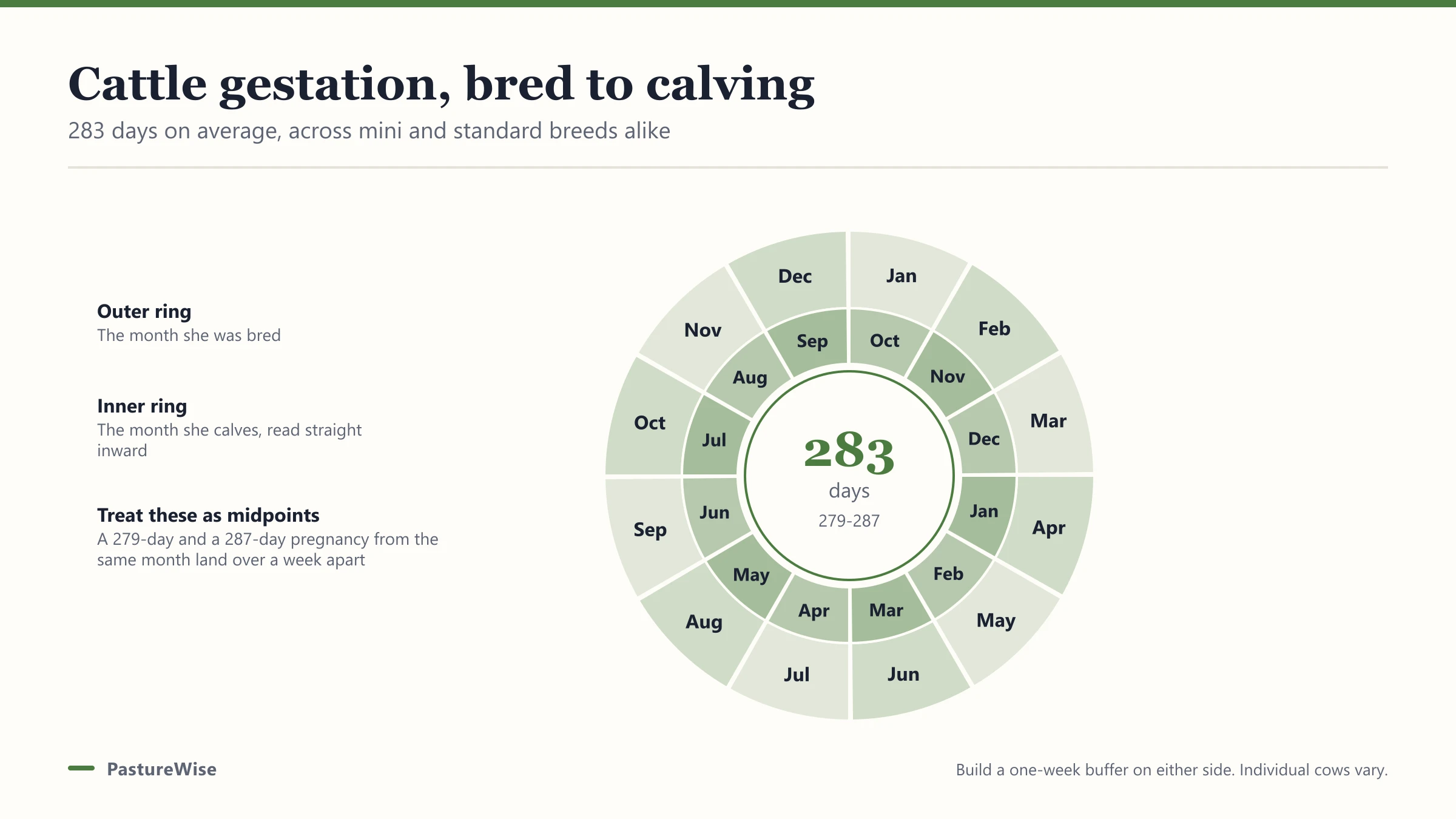
Cattle gestation runs close to 9.5 months, long enough that a breeding decision in spring shapes your calving season, feed budget, and shelter needs a year out. The number is simple; the planning around it is where most new owners get caught off guard.
How Long Are Cattle Pregnant?
Cattle gestation is the time from conception to calving, averaging 283 days, with a normal range of 279 to 287 days. This average holds across breeds and frame sizes: a miniature Highland cow and a full-size Angus carry a calf for essentially the same length of time, since gestation length tracks breed and genetics more than body size.
Cattle Gestation Chart: Breeding Date to Calving Date
Add 283 days to the breeding date to get an estimated calving date. This table gives rough due dates for cows bred in each month, useful for planning hay, shelter, and calving-season labor around your specific timeline.
| Bred in | Estimated calving |
|---|---|
| January | Mid-October |
| February | Mid-November |
| March | Mid-December |
| April | Mid-January |
| May | Mid-February |
| June | Mid-March |
| July | Mid-April |
| August | Mid-May |
| September | Mid-June |
| October | Mid-July |
| November | Mid-August |
| December | Mid-September |
Treat these as midpoints, not fixed dates; build a one-week buffer on either side, since a 279-day and a 287-day pregnancy from the same breeding month land more than a week apart.
Why Most Owners Aim for Spring Calving
Many small-acreage owners deliberately breed for a spring calving window, when pasture growth is picking up and weather is mild enough that a newborn calf is not fighting extreme cold or heat in its first days. That means breeding roughly 9.5 months earlier, in the prior summer, which is worth planning around if you have a choice in the timing. A calf born into a cold snap needs a dry, draft-free shelter ready well before the estimated date; see our baby Highland cow guide for calf-specific care once it arrives.
Confirming Pregnancy Before You Trust the Date
A calculated due date is only as good as the breeding date it is based on, and natural breeding (versus a scheduled artificial insemination) always carries some uncertainty about the exact day. A vet can confirm pregnancy by ultrasound as early as 28 to 35 days post-breeding, and can often estimate a more precise due date at that visit than a calendar guess alone.
Tracking a Due Date Without a Vet Visit
Not every owner schedules an ultrasound, especially on a small operation with a single bred cow. A simple calendar note on the breeding date, cross-checked against this chart, is enough for most planning purposes: ordering extra hay, scheduling time off around the estimated week, and making sure the shelter is ready. Some owners also track heat cycles before breeding to narrow the window further, since cattle cycle roughly every 21 days if a first breeding attempt does not take.
What Changes as Calving Approaches
In the final month, the dam’s nutritional needs increase, and many owners bump hay or add a mineral supplement to support the last stage of fetal growth, particularly over winter when pasture is not covering the gap. Watch for physical signs in the final week or two: udder development, a relaxed tailhead, and a tendency to separate from the herd. These are general husbandry cues rather than a diagnosis, and any concern about a difficult or prolonged labor calls for a large-animal vet, not a guess based on an online chart.
Twin Calves: Rare but Worth Planning For
Twin births in cattle are uncommon, generally cited in the low single-digit percentages of pregnancies, but worth a mention since they change the math on hay and shelter for that calving season if it happens. A cow known or suspected to be carrying twins from a vet check is also a case where extra monitoring around the due date is worth arranging in advance, since twin births carry a higher chance of complications than a single calf.
Mini Cow Gestation Specifically
Because mini cow buyers are often planning around a much smaller pasture and tighter shelter budget than standard cattle owners, the same 283-day average and 279-287 day range applies directly, and the planning stakes are arguably higher: a calving mishap on a small setup has less margin than a large operation with more space and more experienced hands nearby. Our mini cow guide covers the acreage and feed math for keeping a bred cow through calving, and mini cow vs standard cattle compares calving-related space needs between the two.
Keeping Records for Future Breeding Seasons
Once you have tracked one full cycle from breeding date to calving date, keep a simple written or digital record of how close the actual calving date landed to this chart’s estimate for your specific cow. Individual cows are often consistent from one pregnancy to the next, so a personal record built over a few calving seasons can end up more accurate for planning than the general chart alone.
Using This Chart to Plan Your Year
Work backward from a target calving window to a target breeding window, then check that window against your hay supply, shelter readiness, and your own schedule, since calving often needs supervision, at least at a distance, during the first hours. For anyone buying a bred cow rather than breeding one yourself, ask the seller for the confirmed breeding date and treat this chart as your planning tool from day one rather than waiting until the final month to think about it. See our miniature Highland cow guide for breed-specific buying questions to ask if the animal you are considering is already pregnant.
Frequently asked questions
Quick answers to what readers ask us most
Is cattle gestation different for mini cows than standard cattle?
No. Gestation length runs about 283 days regardless of frame size, mini or standard. Breed and individual variation matter more than size, with a normal range of 279 to 287 days across the board.
How accurate is a due date calculated from breeding date?
It is a solid estimate, not a guarantee. Most cows calve within a week of the calculated date, but factors like the calf's sex, the dam's age, and individual variation can shift it a few days earlier or later.
What are signs that calving is close?
Udder filling, a relaxed and swollen area around the tail, and separation from the herd are common signs in the final days. These are general husbandry cues, not medical guidance; contact a large-animal vet if labor seems prolonged or something looks wrong.
Can you use an ultrasound to confirm pregnancy in cattle?
Yes, a vet can confirm pregnancy by ultrasound as early as 28 to 35 days after breeding, well before any visible signs. This is the most reliable way to plan around an actual due date rather than guessing.